

A mediator I know arrived at a community hall with an agenda built around numbers. Compensation tiers. A monitoring schedule. A remediation timeline. Then she looked at the room. A mother sat holding a photograph face down in her lap. A man who had helped carry the dead up from a collapsed shaft stared at a fixed point on the wall and did not move. No one in that room was waiting to bargain. They were waiting to be told that what happened mattered.
That is the situation this article is about, and it is not the situation most mediation prepares you for. When a company and a community disagree over dust from a haul road, a boundary, an employment share, or a monitoring interval, the relationship between them can carry an ordinary negotiation. When a mine collapse has killed workers, when a resettlement was forced rather than agreed, when contamination reached bodies and not only water tables, the relationship itself has broken. The dispute is real, but the dispute is not the wound. Treat a fractured relationship as a fresh negotiation with bad history attached and you do worse than fail. You add a second injury to the first, administered this time by your own process.
REBUILD is the pathway built for that room. It is the trauma-informed mediation method inside Thomas Gaultier’s Social Accord Architecture, the counterpart to the standard GROUNDS pathway, and it exists because not all conflicts are equal and pretending they are causes harm. This piece walks the full method, phase by phase, and explains the design logic underneath it: why you cannot simply start fresh, why acknowledgment has to come before any figure is discussed, and what the practitioner actually does across the months a real repair takes.
Why you cannot start fresh
The instinct after a serious harm is to draw a line and move forward. Everyone wants the line. It almost never holds, and the reason is physiological before it is anything else.
Trauma dysregulates the nervous system. Under reminders of harm, the amygdala drives a threat response while the prefrontal cortex, the part of the brain that plans, reasons, and weighs options, becomes harder to access. Trauma specialists describe a “window of tolerance,” the band of arousal within which a person can stay present and think; sustained trauma narrows that window, so a smaller trigger tips someone out of it. The operational consequence is blunt. A person who is flooded, frozen, or dissociating is not deliberating. They may nod, sign, and comply, and none of it is consent they can later sustain.
This is where the most common repair attempt in the extractive sector goes wrong. Under pressure to contain a crisis, a company convenes fast, opens with an offer, and drives toward a signed settlement. Sometimes people sign. Then, months later, the payments go uncollected, the representatives resign one by one, and young men start turning company vehicles back at the gate. What the process read as agreement was numbness. Families too dissociated by grief to object were not consenting; they were absent, and a deal built on their silence has no foundation under it.
So the past is not an obstacle to clear before the real work starts. For a fractured relationship, the past is the work. Starting fresh asks people to skip the one thing they came for, which is to have the harm named and witnessed by the party connected to it. Skip it and the harm compounds: the unspoken message becomes that the loss did not matter, or that the community brought it on itself, and that message can damage more than the original event did. You are not resetting the relationship. You are attending to an injury inside it.
Two rules that hold the whole pathway up
Before the phases, two design commitments run through every one of them. They look like softness to anyone who has never run a repair. They are load-bearing structure.
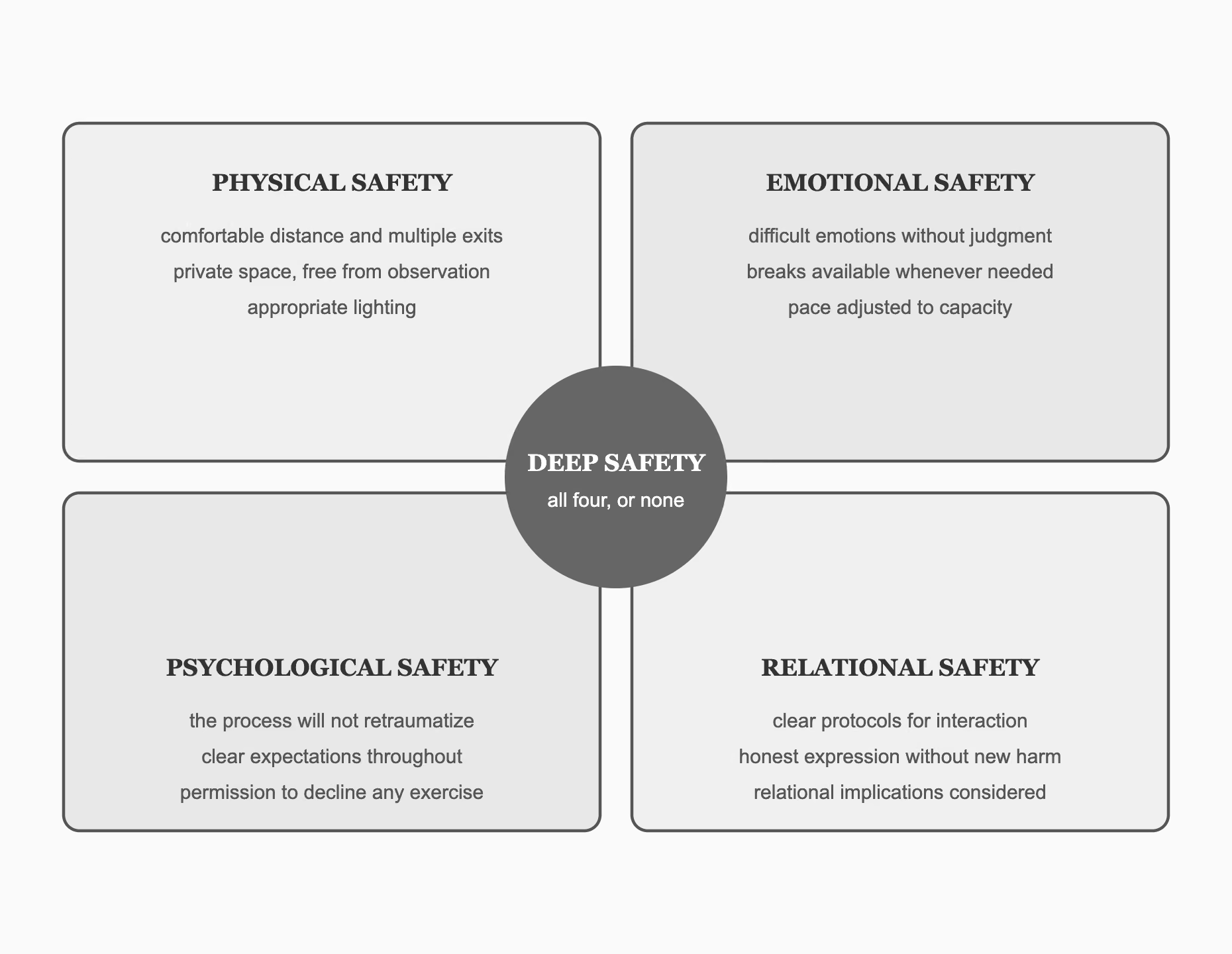
The first is safety, and REBUILD treats it in four dimensions rather than one. Physical safety covers the room: comfortable distance between parties, private space to retreat to, more than one exit, freedom from being watched. Emotional safety means difficult feeling, tears, anger, grief, can be expressed without being shut down, with breaks available the moment they are needed. Psychological safety is the confidence that the process itself will not retraumatize, built through clear communication and explicit permission to decline any particular step. Relational safety sets protocols for how the parties interact, so that honest expression does not become fresh harm between people who will keep living alongside each other after the mediator leaves. Weaken any one of the four and it undermines the other three.
The second rule is sequencing: acknowledgment precedes bargaining, always. This is the principle the opening story turned on. For many people who have been harmed, what they most need first is not compensation or a policy change but recognition that their suffering is real, delivered by someone connected to the harm. The restorative-justice and procedural-justice research is consistent that being heard and receiving genuine acknowledgment reduce distress, fear, and self-blame, and help restore dignity. Reverse the order, open with a number, and you tell the room that the harm was a line item. No agreement built on that footing holds, because the people who signed it were asked to convert what they lost into a figure before anyone admitted there was a loss.
Hold those two commitments in mind, because the seven phases are largely the machinery for delivering them without doing harm along the way.
The seven phases, walked
REBUILD is an acronym: Ready, Establish, Build, Uncover, Invent, Leverage, Deliver. Seven phases, numbered Phase 0 through Phase 6, deliberately parallel to the GROUNDS arc, so a practitioner who knows one can navigate the other’s map. The visible difference is the pause points designed between phases. In REBUILD, permission to stop is part of the architecture, not a courtesy extended when someone breaks down. A pause invoked is the design working, not the process failing. Each phase closes with a guiding question, and the phase is not finished until the honest answer is yes.
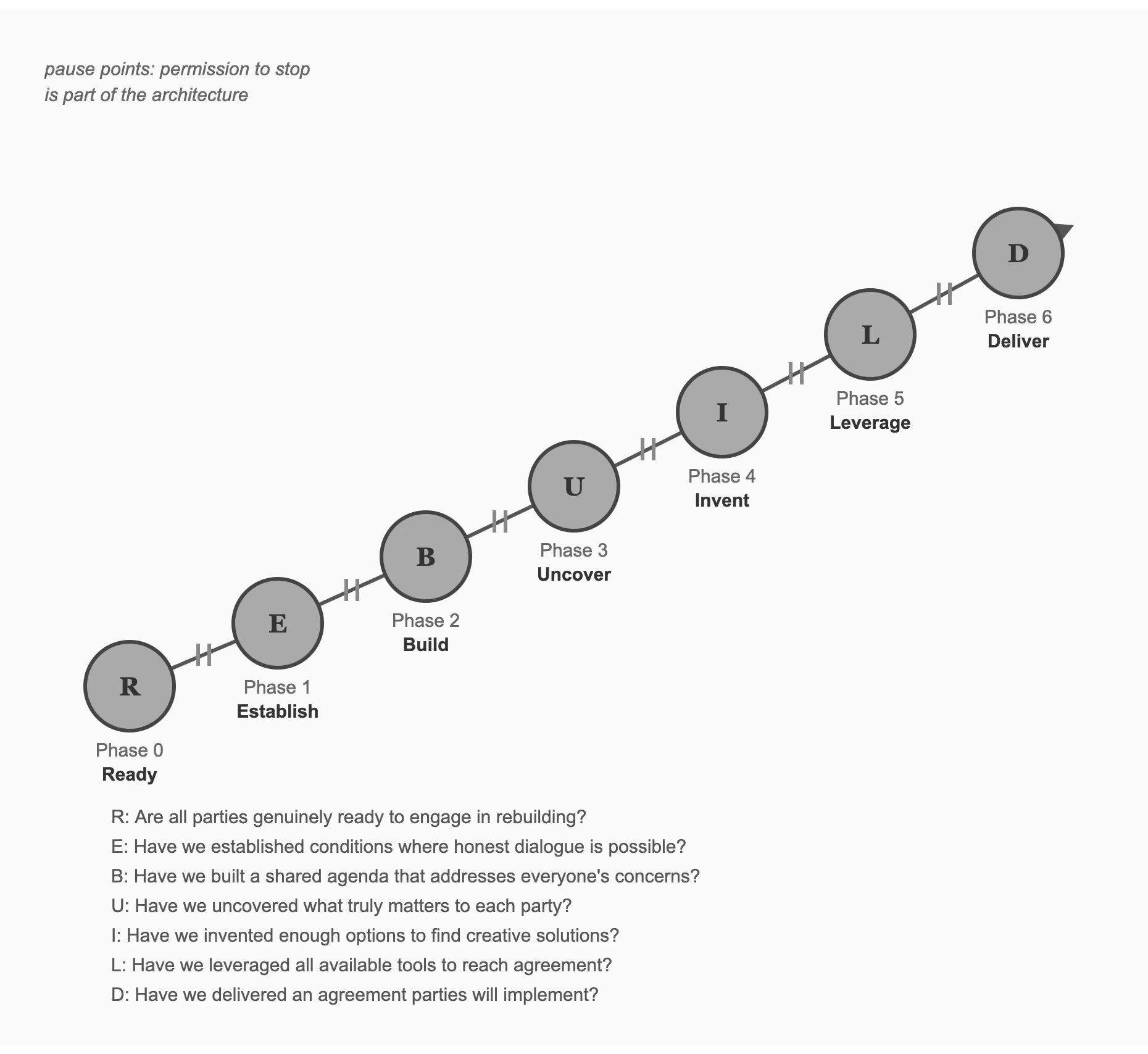
Ready (Phase 0): are all parties genuinely ready to engage in rebuilding?
Ready happens before any joint session. The mediator meets each party alone, sometimes at a kitchen table with the tea going cold, and does three things: screens for trauma without diagnosing it, plans concretely for safety, and assesses whether this person can take part without being harmed again. Screening is a natural conversation, not a checklist: how do you engage when the events come up, what tends to bring the difficult feelings back, who do you turn to when you are distressed, what would need to be different this time. The mediator also maps the support system around each participant and fills its gaps before sessions begin, and teaches grounding techniques while people are calm so they are available under pressure.
The move that matters here is the individual preparation conversation, slower and gentler than its GROUNDS equivalent. The risk that matters is proceeding because the calendar says so. Some parties are not ready, and beginning anyway risks recreating the conditions of the original harm. Readiness has three honest exits, not one: proceed, pause and refer for stabilization, or route the dispute to GROUNDS because it was never a trauma case. Ready also holds a harder judgment: the situations where mediation should not proceed at all, including an active safety threat, a party in acute crisis, coerced consent, or evident bad faith. Naming that line, and holding it against pressure from investors, officials, or NGOs who want visible progress, is part of the competence. Teams often need help deciding whether a situation has even crossed into third-party territory, and the threshold questions in the guide on when to call a mediator and when to trust your own team are the ones worth asking first.
Establish (Phase 1): have we established conditions where honest dialogue is possible?
Establish builds safety deep enough for honest talk, which in a trauma context goes far past ground rules. The mediator arrives early and changes what the room says before anyone speaks: chairs in a loose arc rather than two sides facing off like the accused before a panel, water at every place including the company’s, harsh overhead light softened. People who have been harmed read a room for safety before they hear a word.
The key move is the extended opening that acknowledges harm before any process talk. The practitioner names, plainly and without euphemism, that the accident happened, that lives were lost, that the parties are here because something was broken, and does so without assigning blame on disputed facts. Then each party is briefly validated before any agenda is set. The key risk is counterfeit safety: the right words in the opening, then a brisk pivot to scheduling that tells the room the acknowledgment was a formality. Pace is the proof of sincerity here, and nothing else is believed. When company counsel pushes to “get to the substantive issues,” the honest answer is that understanding the human impact is not preliminary to the real work; it is the real work.
Build (Phase 2): have we built a shared agenda that addresses everyone’s concerns?
Build makes the agenda, and in REBUILD the agenda is larger than the list of things to settle. Standard mediation records the spoken demands, which after a harm are almost always the costable ones, because every prior encounter taught the community that grief and truth are not items a process like this will honor. So they offer what they believe is permitted and keep the rest. A practitioner who writes down only the spoken list builds an agenda that misses the wound.
The move is to legitimize the intangible explicitly, before parties have to fight for it. Acknowledgment, truth-telling, apology, memorialization, assurance of non-recurrence: these go on the shared agenda with the same standing as compensation and timelines. When “the graves, and how they are honored” sits above “compensation framework” on the board, the room learns that healing needs are not decoration around the real negotiation. They are the negotiation. Practitioners often give the community first voice on the order, and communities almost always choose the truth-telling or acknowledgment item first. The risk is an agenda assembled only from what is easy to cost, which asks people to negotiate with most of themselves left outside the door. One caution belongs here: never promise apology on the agenda. Frame the space for it (“an opportunity for the company to respond to what it has heard”), because a promised apology that legal counsel then blocks does more damage than one never raised.
Uncover (Phase 3): have we uncovered what truly matters to each party?
Uncover creates witnessed space for people to say what the harm has meant, individually and collectively, with the witnessing treated as part of the remedy rather than a preamble to it. This is not information exchange. A claim form says crops: a count of cassava plants, a figure for one lost season. Ask the woman what the land was to her and you may learn that her husband is buried at its edge, under a tree he planted, and that the figure on the form was never the loss, only the part of the loss she believed she was allowed to claim. The phase exists for the moment that figure cracks open.
The move is structured witnessing, and it is where the trauma toolkit earns its place. The practitioner works in calibrated doses (titration), deliberately alternates between hard testimony and steadier ground (pendulation), and bounds each session with a clear start and a deliberate close rather than letting it just end (containment). The aim is to keep everyone inside the window of tolerance, which is what separates truth-telling that heals from truth-telling that wounds again. Corporate representatives are prepared to witness, not to defend: to sit with ten seconds of silence after hard testimony rather than reach for a prepared message, because the silence is the respect. The risk runs in both directions. Push too far and you flood people; hurry testimony past out of your own discomfort and you repeat, in miniature, the original experience of not being heard. The mediator also watches their own state, because vicarious trauma is an occupational reality, and weekly debriefing during active cases is the floor, not a luxury.
Invent (Phase 4): have we invented enough options to find creative solutions?
Invent widens the field of repair past compensation. Money has real limits as a sole remedy: it cannot restore a contaminated river or a lost cultural practice, it can deepen divisions if distributed unevenly, and offered without acknowledgment it reads as an attempt to buy silence. So this phase generates options across a wider field, acknowledgment and apology mechanisms, truth-telling processes, memorialization, community healing initiatives, livelihood restoration, cultural and spiritual restoration, and guarantees of non-recurrence with structure behind them. Compensation belongs on the list. It does not exhaust it.
The move is to expand the option field and then test the sincerity of everything intangible. Who would deliver an acknowledgment, in what words, in whose presence, with what authority? An apology drafted by a communications department is an insult with formatting. One caution is worth naming to the room directly: intangible remedies supplement compensation, they never reduce it, and any attempt to trade a memorial for a smaller cheque should be named the moment it appears. A generative question does a lot of work here: “What would your grandchildren need to see to know this was handled well?” It shifts parties out of positional haggling over a number and toward the legacy remedies that neither side had considered. The risk is purely material invention, a generous option set that quietly answers only the costable items and lets the agenda’s leading entries wither, which communities read, correctly, as the process showing its real priorities.
Leverage (Phase 5): have we tested every commitment deeply enough to trust it?
Leverage here does not mean strategic pressure. In REBUILD it means testing and building authentic commitment, because a promise won by pressure collapses the moment the pressure lifts. The phase converts options into commitments that hold two dimensions at once, the practical and the healing, and tests each against both before it binds. A draft apology written by lawyers usually fails this test on the first read-aloud: it regrets that injuries were sustained, but not the act that caused them, and a leader across the table will name exactly that.
The move is sincerity and accountability testing. Acknowledgment language is rehearsed in caucus, the exact words, the speaker, the setting, until the harmed parties confirm it would land as real, and reworked by the person who has to say it until they can mean it. Then accountability is engineered for the moment commitment is lowest, not highest: in the room, with testimony fresh, corporate resolve is at its peak, and six months later a new executive is focused on quarterly earnings and the community’s mediator has moved on. So the mediator traces the implementation chain past the room (“if you left this role tomorrow, what would keep this commitment alive?”) and reinforces it with board resolutions, contractual provisions, independent verification, and clear escalation. The risk is premature closure, a package accepted in fatigue or hope before its healing components are credible, which resolves the file and leaves the wound. This phase also tells the truth about limits: an agreement can create conditions for healing, but it cannot guarantee healing, cannot restore the irreversible, and cannot require forgiveness. Informed hope, not false assurance, is the goal.
Deliver (Phase 6): have we delivered an agreement parties will implement?
Deliver formalizes the agreement without mistaking a signature for closure. Everything can be signed, reviewed by lawyers on both sides, legally binding, and the elders can still say the process is not finished, because the acknowledgment at its center has not yet been spoken aloud in the presence of the people who carried the harm. Until those words are said, the paper is only paper.
The move is to sequence signature and ceremony deliberately and to build the long tail into the agreement itself. Ceremony is not garnish; it is how a community registers that something has ended and something else has begun, and communities design it from their own traditions rather than a mediator’s template. A CEO who flies in, listens to hours of testimony under an open-air shelter, and then stands on the contaminated ground and names, without a legal script, what was damaged there, communicates something signatures never can. Release language is handled with care, because a clause requiring people to “release all claims and hold harmless” can be experienced as a final silencing. The risk is the rushed ending, signatures collected, photograph taken, room emptied, with the ceremonial and the long-term left to goodwill. Implementation begins at delivery; it does not end there. Where closure is incomplete, the honest move is to say so and leave the door open, because communities respect honesty far more than a manufactured sense of completeness.
A repair, walked through the phases
Consider a scenario drawn from patterns across resettlement disputes in the sector, with no real project behind it. Years ago, several hundred households were relocated to make way for a processing plant. Among the unfinished business: graves that were moved badly during the relocation, and one grave that was never found. The grievance resurfaces, as these grievances do, the week new earthworks begin near the old village site.
In Ready, screening finds the family of the missing grave unable to discuss the earthworks without visible distress, and not yet willing to sit with the company. The process waits six weeks, arranges support through a churchwoman the family trusts, and begins only when the family says begin. The earthworks wait too. In Establish, the first joint session runs eighty minutes with two pauses, both invoked by participants, both honored without comment. No agenda is set that day, and the company’s representative speaks twice, briefly, having been prepared for exactly that ratio.
In Build, the agreed agenda runs five items: the missing grave; the disturbed graves and their rites; a public acknowledgment; the families’ livelihoods since the relocation; and the conduct of the new earthworks. Money appears inside two of them and leads none. In Uncover, across two sessions three weeks apart, the daughters of the family speak about the move itself, what was promised that morning, what was loaded onto the trucks, what was left behind. The company delegation is instructed to listen and take no notes during testimony. The second session ends, by design, with tea and with nothing decided.
In Invent, the option work produces a professional survey to locate the missing grave, reburial with full rites at the family’s direction, a small walled memorial at the old village site with the families holding access, a public acknowledgment delivered by the plant’s director in person, a livelihood package, and a chance-finds protocol with community monitors for all future earthworks. The survey carries a hard honesty: it may fail. The families choose it anyway, with the failure case designed in advance, so that if the grave is not found, the memorial carries the name. In Leverage, the director’s acknowledgment text goes through four drafts in caucus; the third is rejected over a single word, and the rehearsal of who stands where at the reburial takes longer than the compensation schedule does. That ratio is correct. In Deliver, the survey finds the grave in the second month, the reburial is held with the director present and speaking the agreed words, and the agreement is signed the following week, in that order, because the families asked for that order and the order was the point.
Notice what the sequence bought. The compensation, when it was finally settled, was close to figures available from the start. The difference was that the number was no longer being asked to carry what a payment cannot carry.
Why REBUILD is not GROUNDS, and not a bigger apology
Set beside GROUNDS, five things change, and they change together. The orientation toward harm inverts: GROUNDS treats competing interests as the center and harm as context, while REBUILD places the harm itself at the center. The past gets a seat rather than a summary. The emotional and the practical swap rank, so acknowledgment and remembrance can outweigh the compensation figure. The pace slows structurally. And the practitioner’s role deepens: a GROUNDS mediator holds a neutral, facilitative presence, while a REBUILD mediator stays impartial about outcomes but is markedly more directive about protecting a traumatized party in the room. Culture runs through all five. Stress responses are universal, but their expression is not; vocal grief in one community, a composure in another that an unfamiliar mediator misreads as indifference. The practitioner’s obligation is not fluency in every culture but the humility to ask and the design flexibility to let the process take local form.
It is just as important to say what REBUILD is not. It is not a therapy session; the mediator borrows tools from trauma practice and knows the boundary that keeps them a mediator. And it is not a single well-staged apology. An apology is one move inside one phase. Deliver it before the harm has been uncovered and it feels hollow; script it in a communications department and it reads as management; force it and it causes more harm than none. What REBUILD provides is the whole architecture that makes a genuine acknowledgment possible and then makes it durable: the screening that gets the right people safely into the room, the agenda that gives the intangible standing, the witnessing that earns the acknowledgment, and the monitoring that keeps the promise alive after the ceremony ends.
The four-element mindset a repair demands
The method asks something of the practitioner that no checklist supplies, and it is worth naming before you take on a repair. Four elements carry it.
Trauma awareness is the first: reading the subtle shifts in body language and engagement that signal someone has been activated or has begun to dissociate, and adjusting before the room tips. Compassionate presence is the second: full attention and genuine care without sliding into friendship or losing professional boundaries. Patience with non-linearity is the third, and it is the one that trips up capable people. Healing does not move in a straight line; a party who spoke openly in one session may retreat in the next, and treating that regression as bad faith rather than as normal will break a process you spent weeks building. Holding hope is the fourth: a grounded belief in the possibility of repair when the parties cannot manage it themselves, without tipping into an optimism the room will read as hollow.
Where repairs fail, and how to avoid it
Three failure modes account for most collapsed repairs, and each maps to a rule this pathway is built to protect.
The first is bargaining before acknowledgment. It is the fast-convene, open-with-a-number reflex, and it produces the signatures that mean nothing. The guard is the sequencing rule: no figure enters the room until the harm has been named and the intangible needs sit on the agenda with standing. If a party cannot yet acknowledge, that is information about readiness, not a cue to press ahead.
The second is rushing the Uncover phase, either by flooding people with too much at once or by hurrying their testimony past out of the practitioner’s own discomfort with strong emotion. The guard is the toolkit: titration, pendulation, and containment keep exploration inside the window of tolerance, and a scheduled close with a grounding ritual lets people set the material down rather than carry it home raw. Depth, not speed, is the measure of this phase.
The third is skipping closure, collecting signatures and treating the ceremonial and the long-term as optional extras. The guard is designing delivery for the low-commitment future: put the acknowledgment, the memorial upkeep, and the anniversary into the monitoring plan, name owners and dates and consequences, and build independent verification for the moment attention has moved on. A healing commitment nobody tracks is a second betrayal scheduled in advance.
How REBUILD sits inside the Social Accord Architecture
REBUILD does not float on compassion. It stands on an international obligation and inside a larger system. The third pillar of the UN Guiding Principles on Business and Human Rights is Access to Remedy, and its recognized forms, restitution, compensation, rehabilitation, satisfaction, and guarantees of non-repetition, map almost exactly onto the REBUILD option field. A reburial, a public acknowledgment, a livelihood program, and a chance-finds protocol are not soft-heartedness. They are that framework, operationalized item by item.
Within the SAA, REBUILD is the trauma-informed counterpart to GROUNDS, and the two are chosen by evidence of what people have experienced, never by which timeline the calendar prefers. GROUNDS carries disputes of interest; REBUILD restores the ground on which the other instruments can work, because a relationship broken by death or betrayal cannot support a benefit agreement, a grievance mechanism, or a monitoring committee until the harm inside it has been attended to. One feature defines the pathway’s place in the architecture: some commitments never close. The memorial’s upkeep, the anniversary, the standing heritage protocol stay on the accord’s agenda permanently, by design, because their permanence is the commitment. Some wounds are not items to be closed. They are relationships to be kept.
Confirm you are running a repair, not a negotiation
Before you convene anything, confirm you are in a REBUILD situation and not a GROUNDS one, then pressure-test whether your process is actually built for it. The REBUILD Repair Readiness Checklist puts that diagnosis on paper. It is a fifteen-item checklist across four sections: routing and severity indicators, safety and preparation, acknowledgment and truth-telling, and closure and durability. It names the concrete triggers that route a dispute to REBUILD, including death or serious injury, a betrayal of trust rather than a clash of interests, contamination that reached health, and prior attempts that broke down on emotional intensity rather than on the numbers. You score each item In place, Partial, or Absent. Any Absent in the safety or acknowledgment sections is a stop sign, not a note for later, because a repair that opens before its safety scaffolding is set will injure the people it was meant to help. Read your Partials as the sequence of work still to do before you convene. Run it once and you will know, before you set foot in the hall, whether you are about to help or to harm. Download the REBUILD Repair Readiness Checklist
Why a mediated repair beats the reactive default
The case for an independent, structured repair over a company’s own crisis containment is not principle. It is failure rates and cost. Company-community conflict imposes large, documented losses on extractive projects, with lost production and forgone future opportunity the heaviest of them (Davis & Franks, 2014). And when a company runs its own containment, the party across the table cannot verify neutrality; a settlement reached under the company’s control is read as a settlement the company wrote. Trust in the process is the one asset a fractured relationship no longer has, which is why an independent third party operating a process both sides can inspect is what makes a fragile agreement credible enough to hold.
The SAA is the structured way to run that repair, and its acknowledgment-first sequencing is what the reactive default gets backward. This is skilled, demanding work; it is also, done honestly, work that can leave a community closer to justice and more at peace than any settlement imposed on it. If you are weighing a repair after a serious harm and want to think it through, or you are unsure whether your situation is a GROUNDS negotiation or a REBUILD one, reach me at thomas@thomasgaultier.com. The full method, the trauma screening instruments, the safety-planning tools, and the sample acknowledgment language are the second half of Rebuild Grounds. The routing test that comes before all of it is the checklist above.