

The best mediation is the one nobody writes about
A drilling program needed access across grazing land. The herders’ association said no, then said worse, and two seasons of goodwill evaporated inside a fortnight of rumor. By the time the council referred it to mediation, the company was pricing a rerouted road at eleven times the compensation under discussion, and two young men had been arrested at the fence. It had every ingredient the newspapers like.
What happened instead was structure. The pre-mediation conversations found the real blockage in the first week. The association’s chairman had signed a grazing agreement years earlier that his members considered a betrayal, and he could not say yes to anything that resembled it. The process was built around that fact. The agenda was rewritten in language both sides could carry home. The options doubled once the herders’ veterinary anxieties sat on the table beside the access corridor. The agreement, when it came, ran four pages with a review clause that has since been used twice, calmly, as designed. Five weeks. No journalists, no war room, no legend.
That is the point of a method. A designed process succeeding is one of the least dramatic events in this industry, and drama is what failure looks like. The blockade, the suspended permit, the rerouted road at eleven times the cost, those are the visible outcomes, and every one of them is a process that was never designed. GROUNDS produces the quiet version. This article sets out how, phase by phase, at enough depth to commission a mediation intelligently and know what good looks like at each stage.
What extractive-conflict mediation demands that generic mediation does not
Commercial mediation usually joins two parties who will part once the cheque clears. A mine and a community cannot part. They are neighbors for the life of the operation and often for decades after closure, which changes what an agreement has to do. It cannot merely end a dispute. It has to leave a working relationship behind it, because the same two parties will be back at the table next year over the next issue.
Three features set this terrain apart. The power gap is structural, not incidental: the company arrives with lawyers, technical staff, and a hundred meetings of practice, while the community may be sitting in its first formal negotiation. The issues interlock, so water, employment, land, and consultation cannot be settled one at a time in isolation. And the stakeholder field is wider than any desk map shows, because the people whose absence breaks an agreement, women’s groups, downstream users, informal leaders, are the ones least visible to an outsider. A method built for a two-party commercial split will miss all three. GROUNDS is built around them.
What GROUNDS is, and where it fits
GROUNDS is the standard mediation pathway in Thomas Gaultier’s Social Accord Architecture, the field methodology that treats the capacity for agreement as buildable infrastructure. It is the structured route for disputes where conflict exists but acute trauma is not the dominant factor: employment, procurement, benefit-sharing, environmental nuisance, consultation breakdowns, land access, resource allocation. The name points at the destination, common ground.
A separate pathway, REBUILD, exists for the disputes that arrive wounded. Any indicator of severe harm routes there on its own: forced displacement, deaths, a tailings failure, contamination affecting health, complete loss of livelihoods, security-force violence, sacred-site destruction, or gender-based violence. Those situations need truth-telling, acknowledgment, and accountability before any conversation about future arrangements can begin, and running GROUNDS on them tells a grieving community that what happened to it falls within the normal range of business disputes. That message compounds the harm. Choosing between the two pathways is a screening decision made before anything else, and it is an ethical judgment as much as a technical one. This article is about GROUNDS, which carries most of the field’s caseload. Where the screen shows one or two harm indicators without a severe one, GROUNDS still applies, run with trauma-aware caution and reassessed at each phase.
GROUNDS runs in seven phases, numbered Phase 0 through Phase 6. Each closes with a guiding question the mediator has to answer honestly before moving on. The arc rises deliberately, from preparation, through understanding, to a durable agreement, and the order is a discipline rather than a suggestion. Groundwork creates the conditions for Rapport. Rapport creates the safety that Organise and Understand need. Deep understanding makes real option generation possible. Only well-developed options can be properly deliberated, and only well-negotiated terms can be secured. A phase skipped early is a collapse deferred, and the debt comes due at the table with interest.
Scale matters too. A GROUNDS process is measured in weeks, occasionally a few months, with sessions on a cadence the parties can sustain alongside their lives. The five-week mediation that opened this article is typical, not exceptional. A standard-pathway process that drags across a year is usually a selection error or a readiness error wearing a scheduling costume.
One illustrative thread runs through the phases to keep them concrete. It is a common scenario drawn from patterns across mining operations near farmland, not any single case. A vegetable growers’ association downstream of a mine alleges that dewatering is lowering the river in the dry season and killing their irrigation. The mine’s data says abstraction is within licence. Watch it advance one phase at a time.
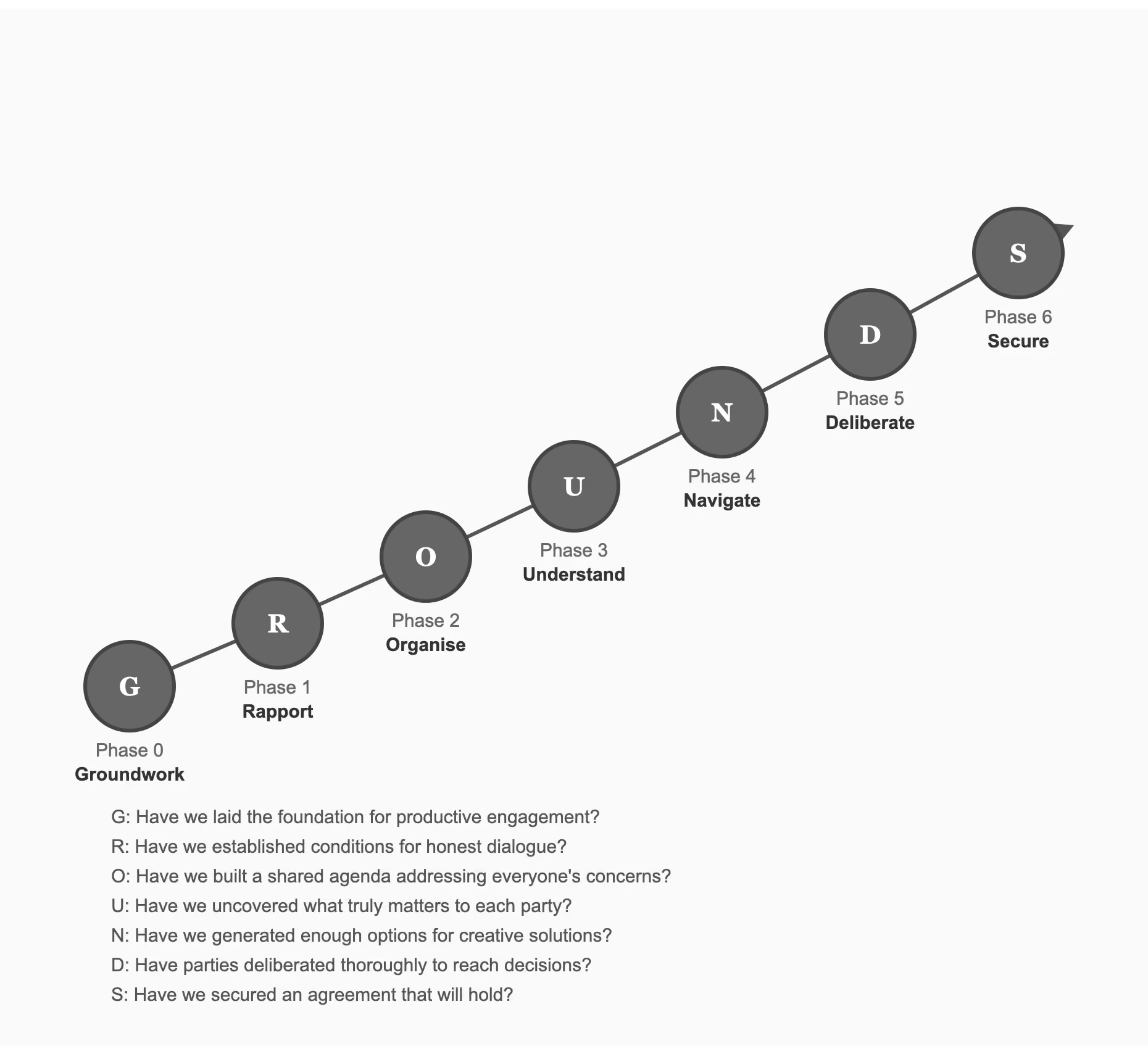
Phase 0, Groundwork: have we laid the foundation for productive engagement?
The goal of Groundwork is a foundation. Know who the parties actually are, whether they are ready, and what the process must be shaped around, before anyone sits at a table. Most failed mediations fail here, invisibly, weeks before they visibly fail somewhere else.
The key move is the pre-mediation conversation. The mediator meets each party separately, listens long, maps the stakeholders behind the stakeholders, and assesses readiness without pressing for commitments. Three tasks run in parallel. Stakeholder mapping casts the net wide enough to catch the primary parties who must sit at the table and the secondary stakeholders, government, NGOs, media, lenders, whose interests surround it. A useful discipline is the “Who else?” test: in every conversation, ask each party who else is affected, who might disagree with any agreement, and whose voice is missing. The answers almost always surface groups the desk map missed. Readiness assessment is the second task, because not every dispute is ripe. A party that still believes it can win outright through litigation, regulatory action, or force has little reason to compromise, and mediating an unripe dispute gives every party a stage and none of them a reason to move. The third task is the mediator’s own foundation: a written agreement to mediate, honest handling of who pays, and a decision on team composition, since a gender-balanced or insider-outsider pair often reaches accounts a solo practitioner never will.
The key risk is skipping straight to the table under schedule pressure, on the theory that talking is progress. It is not. Parties who arrive unprepared discover their differences in public and harden in front of their constituencies, converting a negotiable dispute into a performed one. Done looks like this: all key parties committed in writing, representation confirmed as legitimate and authorized, logistics and a neutral venue arranged, and the mediator satisfied that the dispute is ripe. Groundwork typically runs two to six weeks. It is the phase nobody applauds and the one that decides the rest.
In the water case, two weeks of separate conversations reveal three things. The growers’ association speaks for most but not all of the river. One large grower is quietly negotiating his own side deal. And the mine’s environmental manager privately doubts the calibration of the company’s own flow data. None of this is shared across parties yet. All of it shapes the design.
Phase 1, Rapport: have we established conditions for honest dialogue?
The goal of Rapport is psychological safety, the conditions under which people with reasons to distrust each other can speak honestly anyway. Rapport is not warmth or friendship. It is the parties’ working confidence that the process is credible, the mediator is neutral, and speaking truthfully will not be punished.
The key move is the opening session. The mediator’s statement comes first, setting purpose, process, confidentiality, and ground rules in plain language. Then each party’s opening statement, uninterrupted and of equal length, heard in full. For many community parties it is the first time the company has ever listened to them by rule rather than by indulgence. Two craft details carry weight. The ground rules are co-created and adopted by the parties, because rules people wrote are rules people enforce on each other. And the private conversation with the mediator, the caucus, is introduced now, before anyone needs it, so that asking for one later signals nothing. Difficult moments belong to this phase, not against it. A party who describes real hardship and breaks off, or falls silent, is not derailing the session. The mediator’s job is to hold that space rather than rush to restore order, redirecting personal attacks without suppressing legitimate grievance.
The key risk is assuming trust instead of building it, especially across a power gap. The company delegation has sat in a hundred meetings like this. The growers have sat in none, and treating both as equally at ease quietly favors one. Equal treatment of unequal parties is not neutrality. This is where the core qualities that separate exceptional mediators show first, in whether the room actually feels safe to the weaker party. Done looks like reduced tension, each party’s perspective genuinely heard, ground rules accepted, and enough basic trust to proceed. Rapport is usually a half-day to a full day.
In the water case, the growers’ chairwoman speaks for nine minutes, uninterrupted. She ends on the sentence the whole dispute lives in. Our fathers measured this river in crops, she says, you measure it in liters, and you tell us our measurement does not count. Nobody fixes anything that day. But the mine’s general manager repeats her sentence back accurately in his own opening, and the temperature of the room changes by a degree that turns out to matter.
Phase 2, Organise: have we built a shared agenda addressing everyone’s concerns?
The goal of Organise is a shared agenda: raw grievances and counter-grievances converted into a structured, jointly owned list of issues, in an order that gives the process a chance. A mediation can fail not because parties refuse to agree but because the issues between them arrive as an undifferentiated heap, too large to hold in the mind and too tangled to negotiate in any order.
The key move is reframing. Collect every issue, then restate each in neutral language both sides can recognize without surrendering. “The mine is stealing our water” and “the association is making unsubstantiated claims” become “dry-season flow, and how it is measured and shared.” Reframing is not softening. The issue keeps its teeth. It loses only the phrasing that requires the other side to lose face by discussing it. Every reframe is checked with the party who raised it, because “water quality concerns” is neutral while “alleged water issues” is dismissive, and that distinction matters enormously to people whose lived experience is being described. Sequencing is the move’s second half. Open with something consequential but tractable, because early progress is fuel. Hold the hardest issues until the process has built enough trust to carry them.
The key risk is an agenda that mirrors the stronger party’s lawyer’s letter: five typed headings adopted wholesale because they arrived typed, with the community’s deeper concerns filed under any-other-business. The agenda is the process’s constitution. Whoever writes it alone owns the process, and everyone can feel it. Done looks like a clustered, balanced agenda that every party confirms reflects its concerns, backward-looking grievances balanced with forward-looking topics, and a parking lot ready for issues that emerge later. Organise often takes half a day.
In the water case, the agreed agenda runs four items: dry-season flow and its measurement, irrigation security, communication between mine and association, and the large grower’s side arrangement. The association itself insists on that last item, to the mine’s surprise and the process’s lasting benefit.
Phase 3, Understand: have we uncovered what truly matters to each party?
The goal of Understand is to get beneath positions to interests, from what each party demands to why, because positions collide while interests overlap, and the overlap is where agreements live. It is the phase least forgivable to rush.
The key move is layered interest exploration, organized for this sector’s recurring terrain: economic, cultural and identity, environmental and health, procedural, and reputational interests, on both sides. The questions are simple and the discipline is asking them repeatedly. What makes that important to you. If you got exactly what you asked for, what would be different. What would a good outcome look like five years from now. The mediator listens for interests embedded in stories, since a farmer describing the wall his grandfather built is talking about legacy, not masonry, and keeps a private map of where needs genuinely conflict and where they only seem to. Interests come in layers, and the layer you stop at determines the solutions you can see. A demand of “no mining within ten kilometres of our water source” may sit above an interest in water quality, above one in health security, above one in trust that promises will be kept, above one in control over decisions. Each layer opens a different class of solution: monitoring for quality, verification for trust, participatory governance for control. Some interests stay hidden, whether strategically, unconsciously, or because they feel unacceptable to say aloud, and the caucus is where they surface.
The key risk is stopping at the first stated interest, which is usually the most presentable one. “We need the water” is true and insufficient. Three layers down sits predictability: the growers can plan around a known dry-season flow, but not around surprises. One layer below that sits dignity, being treated as people whose measurements count. Done looks like parties who can articulate each other’s interests, softened positional language, and a visible map of where interests are shared, complementary, or genuinely in conflict. Understand usually runs one to three days.
In the water case, the mine’s load-bearing interest turns out not to be the abstraction volume, which has engineering headroom. It is the licence renewal next year, and a horror of setting a compensation precedent. The growers’ interest is predictability and proof: a flow they can plan on, measured in a way they help control. Two interests that never actually collide, and the dispute begins, quietly, to be solvable.
Phase 4, Navigate: have we generated enough options for creative solutions?
The goal of Navigate is options: more of them, and stranger, than the parties arrived with. Most disputes arrive with exactly two, each side’s opening demand, and a process that only weighs those two is an auction, not a mediation.
The key move is separating invention from decision. For a bounded session, nothing proposed is a commitment, criticism is parked, and volume is the metric. The mediator enforces the separation: that is one option, what else might address the same concern. Hypothetical framing lowers the cost of creativity, because parties will explore in the conditional what they would never concede outright. Two techniques do heavy lifting here. Expanding the pie asks what each side could offer that costs it little but the other values greatly. In mining disputes the asymmetries are real. A company holds construction capacity, technical expertise, and training slots that are cheap for it and worth a great deal to a community. The community holds flexibility on timing, routing, and public support that costs it little and saves the company real money. Contingent agreements handle the cases where parties disagree about the future. Rather than split the difference between two forecasts, index the agreement to what the world actually does, so each side can bet on its own prediction.
The key risk is premature convergence on the company’s pre-built option, the one drafted by head office before the process began, which arrives polished and costed while everything else is still a sticky note. Converging on it may even be right. Arriving there before alternatives exist is not a decision, it is gravity, and the community feels later that the process only ever had one exit. Where the parties cannot yet sit in the same room, shuttle diplomacy between the sides can still generate the options. Done looks like multiple viable options for each interest, ideas from both parties, and some genuinely unexpected combinations on the board. Navigate usually runs one to two days.
In the water case, forty minutes of disciplined invention produce eleven options, four of them new. There is a jointly read river gauge, and a staged abstraction calendar keyed to the growing season. There is a wet-season storage pond on the association’s land, at the mine’s cost, and a seedling-and-drip program that cuts the gardens’ water need by a third. The final agreement will be built from three of them.
Phase 5, Deliberate: have parties deliberated thoroughly to reach decisions?
The goal of Deliberate is decisions: options evaluated against reality and assembled into a package the parties choose, knowing what they are choosing and against what. The expansive invention of the previous phase narrows here into hard analysis of what can actually be built, financed, and lived with.
The key move is reality testing paired with honest alternatives work. Every attractive option is interrogated: who pays, who maintains, what the regulator says, what happens in the driest year on record. Reality testing must fall on both parties with equal rigour, or the mediator’s neutrality is gone, and most of it happens in caucus, where parties can think honestly without losing face. Each party, in private, then examines its genuine alternative to agreement. This is the practitioner’s use of the alternative-to-agreement concept that Fisher and Ury named in 1981: the mediator walks each side through what litigation, protest, or the regulator actually costs and yields, in time and uncertainty rather than rhetoric. A strong alternative deserves respect, a weak one deserves daylight, and honest assessment usually moves parties toward the zone where a deal beats the alternative. In power-imbalanced disputes this cuts both ways: a community’s alternatives carry personal risk and should never be weaponized to force a poor deal, while a company’s apparent advantages carry hidden costs in reputation, social licence, and the operational drag of prolonged opposition. Packaging completes the move, because issues trade across the agenda in combinations single-issue bargaining never finds. A concession cheap for the mine and precious to the growers pairs with one that runs the other way, and the package clears where its parts could not.
The key risk is agreement by fatigue, the deal signed in hour eleven because everyone wants to go home, which is a deal signed by nobody. Exhaustion is the most underrated negotiator in the room. Deliberation needs stamina management, deadlines with breaks, and decisions revisited once before they are final. Done looks like language that has turned declarative where it was conditional, remaining details that are procedural rather than substantive, and parties discussing how to implement rather than whether to agree. Deliberate usually runs one to three days.
In the water case, the storage pond dies under reality testing, elegant and triple the cost of everything else combined, and its death buys credibility for what survives. The package lands as gauge plus calendar plus drip program. The association weighs its alternative, a regulatory complaint with a four-year horizon and uncertain standing, and chooses the package with open eyes. That is the only way choosing counts.
Phase 6, Secure: have we secured an agreement that will hold?
The goal of Secure is an agreement that holds: a verbal understanding converted into documented commitments precise enough to implement and durable enough to survive the people who signed them. Agreement in principle is not agreement in fact. An agreement both sides celebrate can still fail on paper. A “best efforts to hire locally” clause binds no one. A development fund with no rule about who controls the money invites its own dispute. A clause that sends every future complaint to arbitration in a capital the community can never afford to reach denies it any recourse at all.
The key move is SMART drafting with implementation built in. Every commitment is specific, measurable, achievable, relevant, and time-bound, the standard George Doran set out in 1981, here applied to promises that may govern a community and a mine for decades. “The company will support community development” means nothing. “The company will contribute 500,000 dollars annually to the named fund, indexed to inflation” means one thing. The document then carries its own machinery. It defines its terms, so that “dry season” and “local” mean one thing. It sets out the substantive terms. It adds an implementation section naming who does what by when, with what budget, verified how. And it includes a stepped dispute resolution clause, so that disagreements about interpretation go somewhere before they become disputes about betrayal, with local mediation as a genuine first step rather than distant arbitration only the company can afford. A scheduled review completes the structure. The first version of any agreement is a hypothesis, and a review is how a hypothesis gets corrected without a crisis.
The key risk is signing what cannot be monitored, the gloriously vague clause that everyone applauds at signature and litigates at implementation. If compliance cannot be verified by a named person on a named date, the clause is not a commitment. It is a future grievance with a signature on it. Done looks like every commitment meeting the SMART test, governance and monitoring structures in place, community access to monitoring data guaranteed in accessible language, and legal review completed before signature. Secure usually runs one to two days.
In the water case, four pages. A dry-season abstraction calendar with stated flows. A gauge read monthly by one grower and one mine technician together, results posted at the cooperative and the site office. The drip program with a budget, a supplier, and a first-harvest review. A review clause after the first full dry season. The first joint gauge reading draws a small crowd. The third draws nobody, which everyone reads as success.
The design logic of the whole arc
Read across the seven phases and the architecture becomes visible. The first three phases build the container: who is in the room, whether it is safe, and what will be discussed. The middle two do the intellectual work: what each party actually needs, and how many ways those needs might be met. The last two convert all of it into a decision and a durable text. Each phase produces exactly what the next one consumes, which is why order is not negotiable and why a stalled process can almost always be diagnosed by finding the phase it actually skipped.
The arc is not rigidly linear. New issues surface in Navigate that send the process back to Organise. Deliberation can reveal that an interest was never properly understood. In complex disputes, different issues sit at different phases at once, one being drafted while another is still being explored. These loops are healthy, and skilled mediators frame a return to earlier work as thoroughness rather than failure. What holds the whole thing together is not rigidity but a mindset. It takes confidence that a well-run process gives parties their best chance, patience to let it move at the pace trust allows, neutrality that serves both sides while actively leveling the gap between them, and the judgment to know when a phase needs more time before it closes.
This is also where GROUNDS parts company with conventional commercial mediation. A commercial mediator can often open at the equivalent of Phase 3, because the parties are roughly matched, the issue is bounded, and the relationship ends at settlement. GROUNDS refuses to reach agreement before the ground is prepared, the interests are understood, and the options exist, precisely because the parties will still be neighbors when the mediator leaves. That refusal is what separates a durable four-page agreement from a hundred-and-forty-page document that dies within a year.
Where practitioners rush, and what it costs
The failures cluster at predictable points, and every one is a phase treated as a formality. Groundwork gets compressed under pressure to show progress, so the table is set before anyone knows who belongs at it, and an unmapped women’s cooperative or downstream user surfaces mid-process to reopen everything. Rapport gets skipped as “preliminary,” so parties who never felt heard negotiate defensively for weeks over what is really a relational wound. Organise gets handed to whoever arrives with a typed list, so the agenda encodes one party’s frame and the other spends the process feeling cornered. Understand gets cut shortest of all, because interest exploration feels slow next to problem-solving, and the options that follow end up splitting positions that satisfy no one. Navigate collapses into the company’s pre-built plan before alternatives exist. Deliberation runs past exhaustion into agreement by fatigue. And Secure ends in vague language that everyone applauds and no one can enforce.
The common thread is that each shortcut saves visible time now and spends far more of it later, usually in public. A phase skipped does not disappear. It reappears as an implementation dispute, a reopened negotiation, or a collapsed agreement, on worse terms and with less trust than the first time. The discipline of answering each guiding question honestly before advancing is not bureaucratic caution. It is the cheapest insurance available in this work.
How GROUNDS sits inside the Social Accord Architecture
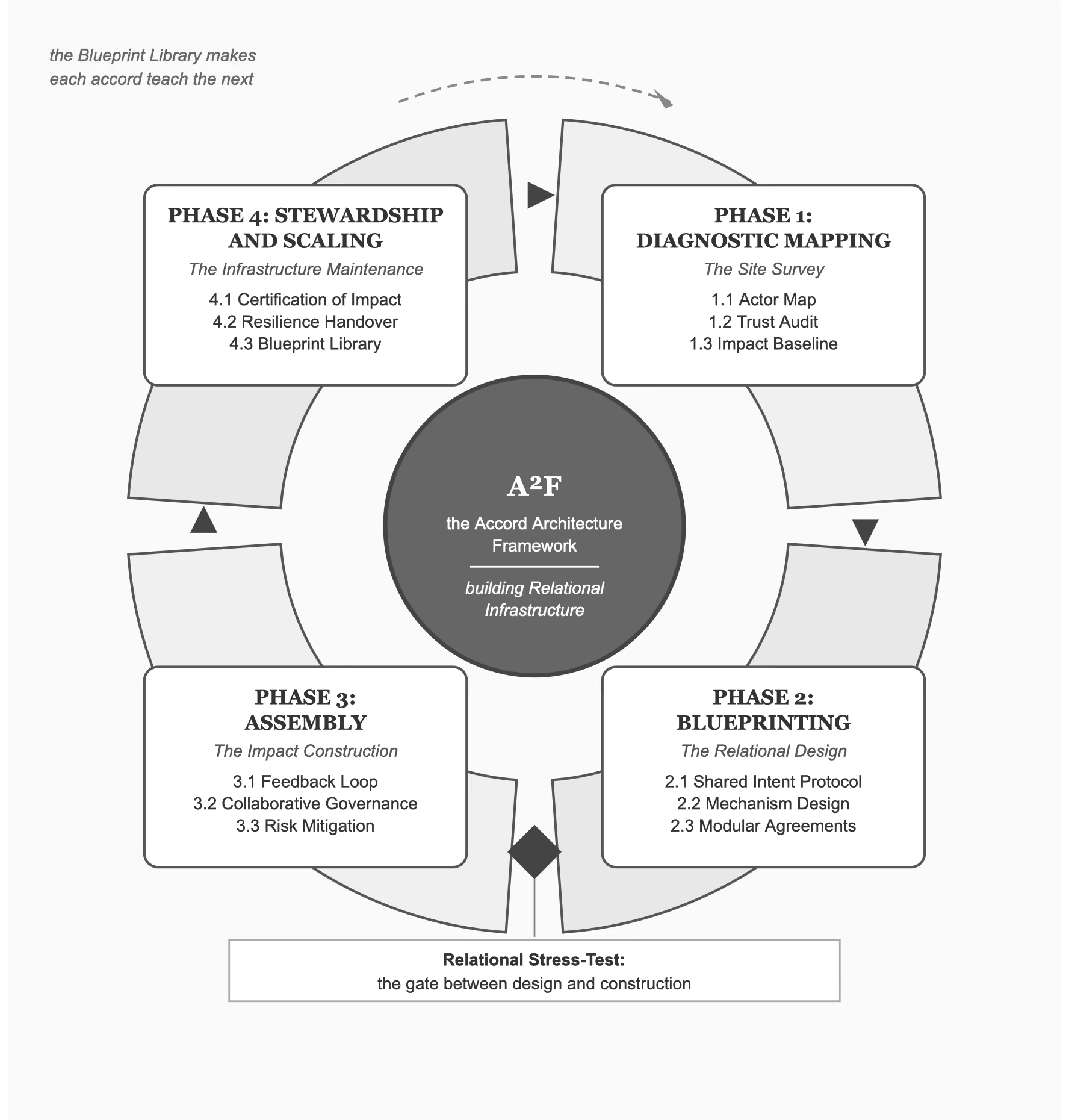
GROUNDS is the mediation core of the SAA, and it does not run in isolation. Inside an accord it arrives after the diagnostic work is done: the Trust Audit has already mapped where trust exists and where it is damaged, and the Shared Intent Protocol has already moved the parties from positional demands toward a shared goal. Groundwork inherits those instruments and verifies them against the live dispute rather than building them from scratch. Run standalone, without an accord around it, Phase 0 simply works harder, building dispute-sized versions of the map and the audit before anything else. The arc is identical in both settings. Only the starting inventory differs.
Its outcomes do not vanish when the mediator leaves. The agreement’s monitoring items become named sensors that feed the accord’s feedback loop, with owners and rhythms. Its terms amend the Blueprint through the amendment rules, not around them. Its register entries join the single commitments register the governing council oversees. And the process itself is archived, scenario, breaks, repairs, and lessons, into the Blueprint Library, so the next mediation starts smarter than this one. Eventually the accord’s governance transfers to local stakeholders through the Resilience Handover, without leaving them dependent on the practitioner who built it. Run inside an accord, mediation does not interrupt the architecture. It feeds it.
Run the arc before you commission a mediator
The companion GROUNDS Mediation Pathway Roadmap lays the method out as a working sequence you can hold beside a live dispute. It opens with a short screening step, GROUNDS or REBUILD, then walks all seven phases in order: Groundwork, Rapport, Organise, Understand, Navigate, Deliberate, Secure. For each phase it states the goal, the guiding question you must answer before advancing, the one key move the phase turns on, the characteristic risk that sinks it, the typical duration, and what “done” looks like before you move on. Groundwork, for instance, pairs “have we laid the foundation” with the pre-mediation conversation as the move, rushing to the table as the risk, and written commitments from all parties as the done signal. A closing section names the seven failure modes to watch for. Use it two ways. Run it as a readiness check before you commission a mediation, to see whether the process is being run or merely scheduled. And keep it as a live map during one, to locate which phase a stalled process is actually stuck in. Download the GROUNDS Mediation Pathway Roadmap.
Why the method beats the improvised alternative
The reflexive alternative to a method is improvisation: convene a meeting, let people vent, and hope goodwill carries the day. Goodwill and effort are rarely what is missing in these disputes. Structure is. Without a shared sense of what phase the process is in and what it must accomplish, each meeting attempts to tell stories, define issues, and negotiate solutions all at once, and accomplishes none of them. Positions harden with every unstructured ending. That is the mechanism behind the dramatic failures, and a mediated, phased process is the practical answer to it. It is also the honest answer to when to bring in a mediator rather than trusting your own team. Once positions have hardened and the internal channel has stalled, a neutral running this arc is what moves it. The neutral can do what a party cannot: hold the process open long enough for interests to surface and options to exist.
If you are facing a dispute that has hardened past your own team’s reach, map it against the seven phases before you act, and start with the groundwork, because the phase everyone wants to skip is the one that decides the rest. To talk through a specific situation, reach me at thomas@thomasgaultier.com.